texte
June 17, 1953
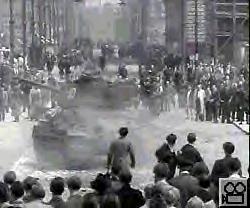
The insurrection of the June 17th in the GDR was the first of many
rebellions. The countries that were conquered from the Soviets during the
Second World War were fighting against the People’s Republic. The People’s
Republic was dictatorships with a one party system that was set up according
to the demand of Moscow. With a belt of states that had a friendly attitude
towards them wanted the SU to save the conquered territory and use it
economical. The western side had a different kind of method dealing with their
occupied zones. Moscow weakened their German territory through paying
reparations (the deportation of industry for the balance of the destruction in
the Nazi period) for years. The GDR’s
qualification to get a grip on the normal kind of foundation again was way
worst compared with its counter part. America had invested in Germany to
rebuild the German economy. The resentment against the economic and political
conditions in the east was always huge. 1956 after the GDR different countries
like Poland tried to destroy this system. The CSSR went 1968 a different way
with the “Prager Frühling”. They tried a reform from the interior of the party
under Alexander Dubček.
This reform period only lasted for half a year parallel to the revolts in
America (cause the Vietnam War), in Germany and France the reform was ended
by the Soviet invasion in Prag. 1980 Poland tried again with the Solidarnosc-movement,
coming from the workers in Danzig, with Lech Walenca as
leader supported by the just elected polish pope who is still in office today
to find a solution for the inner structure with the workers as participants in
this power-system. 1985 this movement finally reached the Soviets with the
election of Gorbatschow as secretary general of the KPdSU
and his open political system. 1989 this movement lead to the fall of Honecker who was against Gorbatschow. Over Prag, Warsaw, Bucharest
the feeling of getting rid of the Soviet regime was spreading out
an it finally lead to tumble-down of the
Soviet-Union in 1991 and the getting rid of that what was left over from the
Second World War Stalin was admired and threatened like a God.
Stalin’s
death in March 1953 was an event that raised hope everywhere that the new
leader would relax the tied grip on Europe. The new Soviet leadership even
thought about unifying Germany again at least it was expected that Walter
Ulbricht the East German leader would resign
but the opposite happened he tried through ambitious economy plans to get out
of the crisis. Nothing really changed after Stalin’s death the causes were
that small Revolts broke out all over the country and they were quickly
eliminated.
It was in late may when the USSR appointed a civilian to the state of a High
Commissioner of the Eastern zone of GDR this also meant the Soviet military
control was kept up over that area. After a while the government announced
that they would keep the collective farm program at its present level and that
they would also restore the confiscated property and East German refugees who
returned receive the full civil rights. All those things were made to avoid
riots but there was no way avoiding what was nearly ready to appear. The
communist government just had too many issues for the people.
The first protest was the Berlin uprising of 16- 17 June. The workers were fed
up with the newly increased amount of money that was paid for a certain time
of work. The wanted more because the work was really hard but the pay check
was not worth working that hard after the chemical workers in the
Halle/Saale district went out for a strike also in
Berlin construction workers who built the prestigious Stalin-Allee
(today Frankfurter-Allee) went on the street and
demanded for a better work quota and that means better payment. This
demonstration only kept on for about three hours but it was not over.
This was just the beginning of a huge protest which brought ten thousands and
more people on the street. The traffic was completely shut down and the
demonstration was very violent. Thousands of rebels swarmed from the “Potsdamer Platz”
to the “Lustgarden” ripping down red flags from the official buildings. The rebels also overturned
kiosk and police stations and smoke columns were steaming out of the
government’s main office building. With this riot the resentments against the
regime gained way more force and got stronger and because the riots Walter
Ulbricht was asked in the Polit Bureau (the highest council and the power centre of the communist
party and the country) very forcefully to step down.
But Ulbricht made it getting the support from the
Soviets against his party competents in the Polit
Bureau and the riots. Ulbricht engraved the Soviet
system of politics during his exile time in the Nazi period deeply in his
conscience and that was also a reason why he didn’t lost his grip during this
difficult period of time. The Soviet troops and the armed forces had quietly
moved into East Berlin the previous night after the first riot from the
construction workers happened.
Those forces were unfortunately very well armed, 15 Soviet medium tanks, 20 armoured cars and at least 30 truckloads of
machine gunners were aiming at the 50,000 man crowd storming the government
headquarters. The troops had no mercy on nobody
the violence was expanding really fast. This fight was totally cruel. The
crowd that was close to the government headquarters was in the worst kind of
situation. The tanks were just driving into the crowd of people trying to
split them apart. Many people were wounded because they had been hit by a
bullet or smashed by a tank. All the injured people were taken to the closest
hospital. Thousands were arrested by the soviet troops and had to go through a
severe penalty system.
The crowd of rebels didn’t even had a tiny chance
to fight against this Soviet equipment. After the Soviet and armoured police
troops had taken over the riot the East Berlin the radio station announced a
very important point. They called out a state of emergency in the Soviet
Sector and because this state of emergency occurred was
a curfew time proclaimed for that night. Everybody that violated this time
received a very hard punishment so it was nearly impossible to sneak around a
corner and not to be seen and punished by the Soviet troops.
After this announcement was made it seemed that the most serious local
disturbances had been brought under complete control. Also other announcements
called out from the East German radio station threatened the insurgents and
minimized the uprising.
When the curfew time was over there was a SED meeting which referred in many
cases to the SED meeting the previous evening in which Ulbricht
had said that the whole party should listen way more carefully to the
criticism of the workers and what they demand for. The prime minister promised
to higher the living standard and to increase the supply of needed living
goods for the people.
With the election of Nikita Chruschtschow as the new leader of the party 1953
the whole situation changed. Chruschtschow started slowly to get the Stalin way
of thinking out of the system the strong structure was softened and the crime
was shown that Stalin committed. The GDR followed slowly and started with the
building up of the central intelligence called StaSi.
This kind of program was made to prevent such a thing what happened on the
June 17th. The Soviet-union still tried to keep up their power with
the found of the Warsaw Pact. The climax was the Wall which was built up
between East and West made out of concrete but it wasn’t really worth it
because it lead to a peaceful revolution which
changed everything anyway.
© Benjamin Siegert, January 2002
The Vietnam War
In the year 1930 Indochina’s communist party opposed to French rule led by Ho Chi Minh and his followers. Shortly after that Bao Dai returns from France to be emperor of Vietnam under the French rule. In 1940 the Japanese troops conquered Indochina but permitted the French to keep their colonial administration in that area. The Japanese troops move into southern Vietnam this triggers of an oil boycott from the USA and Britain.
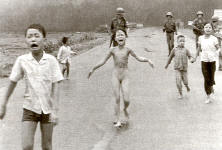
This shortage
strengthened Japan’s desire to risk war against the USA and Britain. A
forerunner of the CIA, the OSS, saved Ho Chi Minh,
totally sick from tropical diseases out of the deep jungle five years later.
In the same year the Japanese troops surrender and the saved Ho Chi
Minh establishes the Viet Minh, a guerilla army. Bao Dai abdicates
after an uprising led by the Viet Minh. Later in
September Ho Chi Minh reads Vietnam’s Declaration
of Independence and establishes the Democratic Republic of Vietnam in Hanoi.
This was also
the division of Vietnam. A fight starts between the Vietminh and the French
because they blame each other for the deaths of the first Americans in
Vietnam. Ho Chi Minh attempts to negotiate the end
of colonial rule with the French without success. The French army killed at
Haiphong harbor over 6000 Vietnamese civilians. That event triggers of a war between
France and the Viet Minh. The USA recognized the
Boa Dai regime as legitimate. The supplies to the French in Vietnam were
stopped. Chinese Communist that won their civil war supplied the Viet
Minh with weapons.
The Postcolonial War
The French army is defeated May 1954 at Dien Bien Phu. Soon after
that the CIA establishes a military mission in Saigon. The Geneva Conference
declares a demilitarized zone at the 17th parallel. President
Eisenhower pledges support to the new prime minister of
Bao Dai.
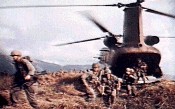 The
USA also backed the new Prime
Minister Ngo Dinh Diem organizing the
Republic of Vietnam as an independent Nation and he also declared himself as a
president. On the 8th of July 1959 the first American combat deaths
in Vietnam occur.
The
USA also backed the new Prime
Minister Ngo Dinh Diem organizing the
Republic of Vietnam as an independent Nation and he also declared himself as a
president. On the 8th of July 1959 the first American combat deaths
in Vietnam occur.
Two servicemen are killed during a Viet Cong attack on a building. 1960 the
National Liberation Front (NLF) also called the Viet Cong is founded in South
Vietnam. A little bit later the USA starts building up military in Vietnam. A
Buddhist monk sets himself on fire; this was one of many demonstrations that
occurred between May and August. In November 1963 Diem is assassinated. North
and South Vietnam attack each other, the Gulf of Tonkin Incident triggers of
the Vietnam War. In Tonkin the US destroyer Maddox is attacked by North
Vietnamese torpedo boats.
The War
A second attack happens right afterwards. The American Congress searches for a
solution.
The Congress approves the President Lyndon B. Johnson to take
necessary measures to defeat further attacks. President Johnson ordered the
bombing on North Vietnam shortly after he had the permission to. In March 1965
the first combat troops arrived in Vietnam and President Johnson offers North
Vietnam peace but they rejected the offer. Anti-War demonstrations toke place
in Washington D.C. and soon in approximately 40 American cities. A new
President named Thieu seized power in South Vietnam.
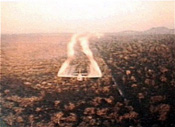 In January 1968 the Tet Offensive starts. Communist forces
launch attacks on many South Vietnamese cities and also on the US embassy in
Saigon. It took a long time for the Americans to completely wipe out the Viet
Cong troops. US-Army member kill about 150 innocent Vietnamese civilians. The
Paris peace talks took place in May where U.S. and Vietnamese officials tried
to negotiate the problem. But nothing helped the Battle of Hamburger Hill is
one of the cruelest battles in the Vietnam War. About 1000 people are wounded
or killed.
In January 1968 the Tet Offensive starts. Communist forces
launch attacks on many South Vietnamese cities and also on the US embassy in
Saigon. It took a long time for the Americans to completely wipe out the Viet
Cong troops. US-Army member kill about 150 innocent Vietnamese civilians. The
Paris peace talks took place in May where U.S. and Vietnamese officials tried
to negotiate the problem. But nothing helped the Battle of Hamburger Hill is
one of the cruelest battles in the Vietnam War. About 1000 people are wounded
or killed.
The new US President Richard Nixon announces in June 1969 the first troop
withdrawals out of South Vietnam. In September 1969 Ho Chi Minh passes away.
Ways to Peace
The War demonstrations are getting stronger and stronger in Washington D.C. over
250.000 people are one the street. The South Vietnamese army and the U.S.
invade Cambodia and Laos. In America over 100 schools are closed due to
student riots. A huge bombing happens in Hanoi right before Christmas. The
USA, North Vietnam and South Vietnam sign the Paris Peace Accords. This treaty
ends the American combat role in the war. Finally also the U.S. military draft
ends. In March 1973 the last American combat battle troops leave Vietnam. 1975
President Thieu of South Vietnam finally resigns.
North Vietnamese forces take over Saigon; the US navy evacuates US personnel and
South Vietnamese refugees. The South Vietnamese President surrenders. This
event ends the war and also reunifies the country under communist control.
North Vietnam invades Cambodia and a US merchant ship is brought under
control. Non-communist forces in Asia and Europe support a new US embargo
against Vietnam in protest of the invasion of Cambodia. Vietnam starts talks
with American MIA members. The Vietnam Veteran Memorial is dedicated in
Washington in November 1982.
Vietnam begins to cooperate with the US and starts withdrawing troops out of Cambodia.
An US office is established in Hanoi to find out about the huge war losses in Vietnam.
Steps to Normalization
1991 Vietnam supports the UN peace plan for Cambodia. In the same year the US also lifts
the Ban on organized US travel to the country Vietnam. Washington also eases
the trade embargo with Vietnam and also allows the establishment of
telecommunications. Everything turns back to normal George Bush
grants the permission for US companies to do studies in Vietnam and Bill
Clinton eases economic shortages against Vietnam, which is just another
step forward to normalization.
 The Americans
are still trying to find out the number of the fallen US men in the war.
Clinton lifts up the trade embargo, to get a full account of the Americans
still listed as missing in the Vietnam War. In January 1995 the US and Vietnam
sign a treaty to solve old territorial claims. On the 30th of April
Vietnam celebrates the 20th anniversary since the ending of the
war. Vietnam gives the US detailed documents on the missing Americans and 100
papers of reports about US servicemen killed during the war.
The Americans
are still trying to find out the number of the fallen US men in the war.
Clinton lifts up the trade embargo, to get a full account of the Americans
still listed as missing in the Vietnam War. In January 1995 the US and Vietnam
sign a treaty to solve old territorial claims. On the 30th of April
Vietnam celebrates the 20th anniversary since the ending of the
war. Vietnam gives the US detailed documents on the missing Americans and 100
papers of reports about US servicemen killed during the war.
Many people still urge towards the normalization of the relations between US and Vietnam.
Formal diplomatic relations with Vietnam are established, and President
Clinton announces to move forward and to blind up the wounds of the war. In
July 1995 Vietnam becomes a member of the Association of Southeast Asian
Nations. A big US embassy is opened in Hanoi.
The former President George Bush, the former Secretary of Defense and the National
Security Advisor visit Vietnam to mark the first anniversary of normalization.
The USA and Vietnam reach the agreement of copyright protection; this is a
step forward to the most favored Nation status. The elected American
ambassador Peterson arrives in Hanoi and the elected Vietnamese ambassador Le
Van Bang arrives in Washington. America offers financial help to Vietnam.
Treaties are signed between the US and Vietnam which allows Vietnam the access
to the US market and this also completes the long term process of
normalization.
In November 2000 Clinton
is the first President to visit Vietnam since Nixon in 1969. He goes on that
trip with his family and it seems like a historic visit. Clinton said that he
thinks its time to write a new chapter. A new trade agreement is put up
between those two countries to improve the trade status. The Vietnamese
government voiced strong concerns and that any US interference in Vietnam’s
internal affaires could jeopardize the agreement. But the relations between
Vietnam and the US improved in a high degree after the war ended everything
returned back to normal.
The Vietnam War was the first fully televised war. Every day people worldwide viewed the
pictures of burning villages, forests, and children. So the opposition against
this war grew day by day. Twenty years later with the
Gulf War I,
called operation
desert storm, the press was
censored, permitted only backstage the "war theatre".
Officers explained what journalists should show about the new computerized
"clean war".
CNN was the only station to cover the bombing of Baghdad
directly for a short time. Later on the reporter Peter Arnett was
dismissed .
© Benjamin Siegert, April 2002